
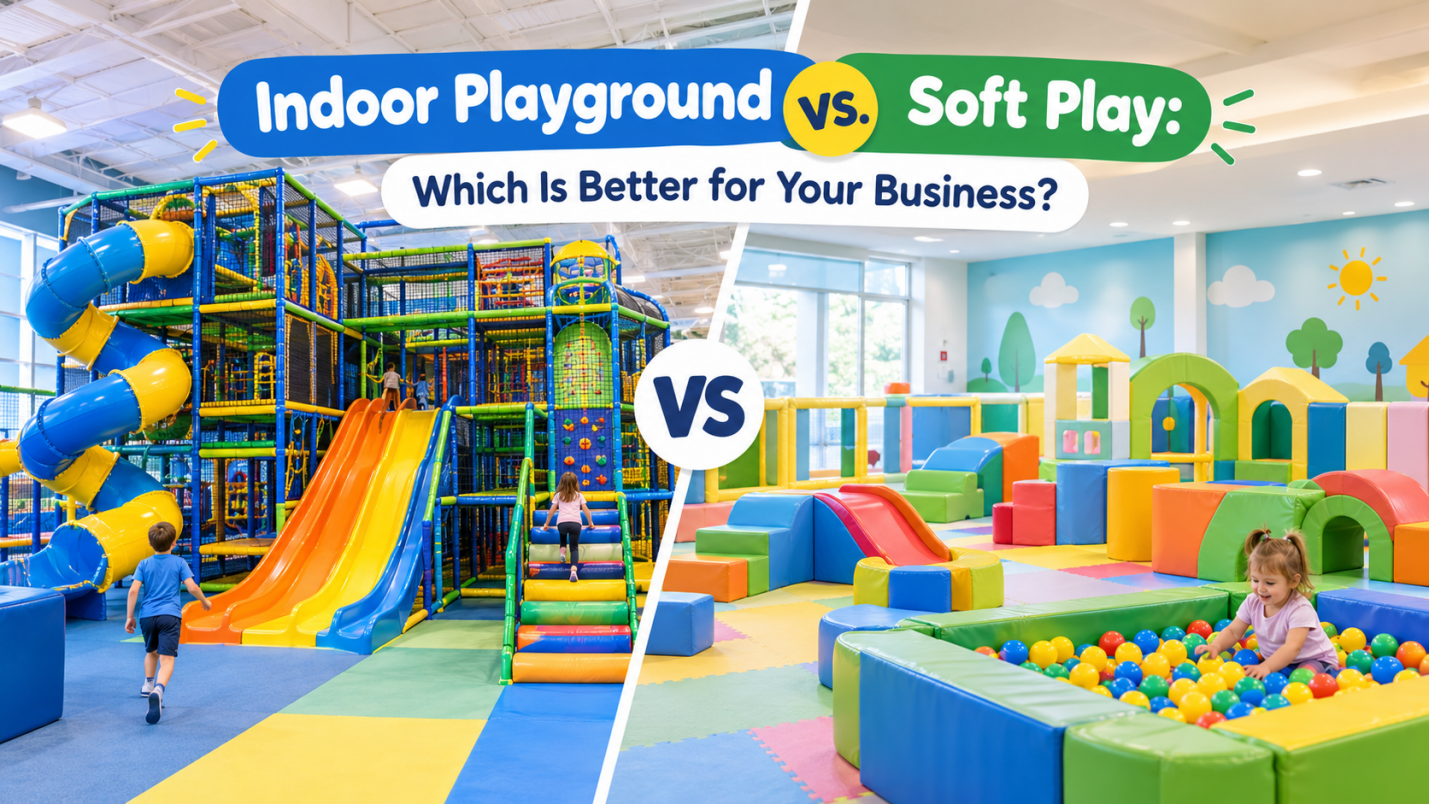
Anyone shopping for a new play attraction eventually runs into this fork in the road: build a full indoor playground, or go with a soft play setup instead. The two get lumped together constantly, but they serve different age groups, different budgets, and different business models. The indoor playground vs soft play decision isn’t about which one is objectively better — it’s about which one matches your space, your target customer, and how you plan to make money from the room.
What Actually Separates the Two
A traditional indoor playground is built around height and complexity: multi-level structures, slides, cargo nets, tube crawls, and climbing walls, usually aimed at kids roughly five to twelve years old. Soft play equipment, by contrast, is padded, low to the ground, and designed with toddlers and preschoolers in mind — think foam blocks, low slides, ball pits, and gentle climbing shapes with rounded edges. Both fall under the umbrella of indoor playground equipment, but the engineering, safety requirements, and typical customer experience are quite different. A parent bringing a two-year-old wants soft edges and low fall heights; a parent with an eight-year-old wants something with enough challenge to hold their attention for an hour.
The Case for Soft Play
Commercial soft play equipment tends to have a lower upfront cost and a smaller footprint requirement, which makes it the more accessible entry point for a lot of new operators — cafes adding a play corner, daycare centers building out an indoor recess option, or small family entertainment venues testing the waters before committing to a bigger build. Soft play area design also tends to be more forgiving of irregular or low-ceiling spaces, since most soft play structures top out well under eight feet. If your target customer is parents with children under five, or if you’re running a business where play is a secondary attraction rather than the main draw, soft play often makes more financial sense. It’s also easier to keep clean and sanitized, which matters a great deal to parents of very young children.
The Case for a Full Indoor Playground
If your business model depends on longer visits, higher per-child spend, and a broader age range, a full indoor playground usually wins. Multi-level indoor play structures keep older kids engaged far longer than soft play alone, which translates into longer party bookings, more concession sales, and better word of mouth among the exact demographic — parents of school-age kids — who tend to book birthday parties and group events. Commercial indoor play areas built around taller structures also photograph better for marketing, which shouldn’t be underestimated in a business that depends heavily on social sharing and local visibility. The tradeoff is cost and space: a proper indoor playground typically needs more ceiling height, a larger footprint, and a bigger initial investment than a soft play area.
Many Successful Venues Do Both
The most common answer in the industry isn’t actually “either/or” — it’s both, zoned separately. A dedicated soft play business, or simply a soft play corner for toddlers next to a taller structure for older kids lets one venue serve the entire family in a single visit, rather than turning away parents with kids of different ages. This hybrid approach is especially common in larger family entertainment centers, where a soft play zone captures the youngest siblings while the main attraction holds the older kids’ attention. If your space and budget allow for it, splitting the floor plan this way tends to outperform a single-age-range venue on both visit frequency and average spend per family, since parents don’t have to choose between two separate outings.
Matching the Choice to Your Business Model
Before deciding, it helps to get specific about who you’re actually serving. A venue near a preschool district or in a residential area with a lot of young families may do better leaning soft play, at least to start. A venue positioned as a birthday party and group event destination, competing with trampoline parks and family entertainment centers, usually needs the taller structures and longer play cycles a full indoor playground provides. Budget matters too — soft play equipment generally costs less per square foot and installs faster, which shortens your time to opening day and reduces the capital you need before the first customer walks through the door. A full custom structure costs more but tends to generate higher revenue per square foot once it’s running at capacity, particularly through party packages and membership models.
Don’t Overlook Maintenance and Staffing Differences
Soft play equipment is generally easier to maintain — foam and vinyl surfaces wipe down quickly, and there are fewer mechanical or structural components to inspect. Taller indoor play structures require more rigorous ongoing inspection, particularly around netting, connection points, and slide surfaces, along with more attentive staff supervision given the greater fall heights involved. Factor these ongoing costs into your comparison, not just the upfront build price, since they affect your margins for as long as the equipment is in use.
There’s no universal winner in the indoor playground vs soft play debate — only the option that fits your customer base, your space, and your growth plans. Soft play gets you into business faster and serves the youngest visitors better; a full indoor playground captures older kids and typically drives higher revenue per visit once established. If your budget and footprint allow it, combining both into distinct zones is often the smartest long-term play, letting a single venue serve the whole family instead of just one age group.