
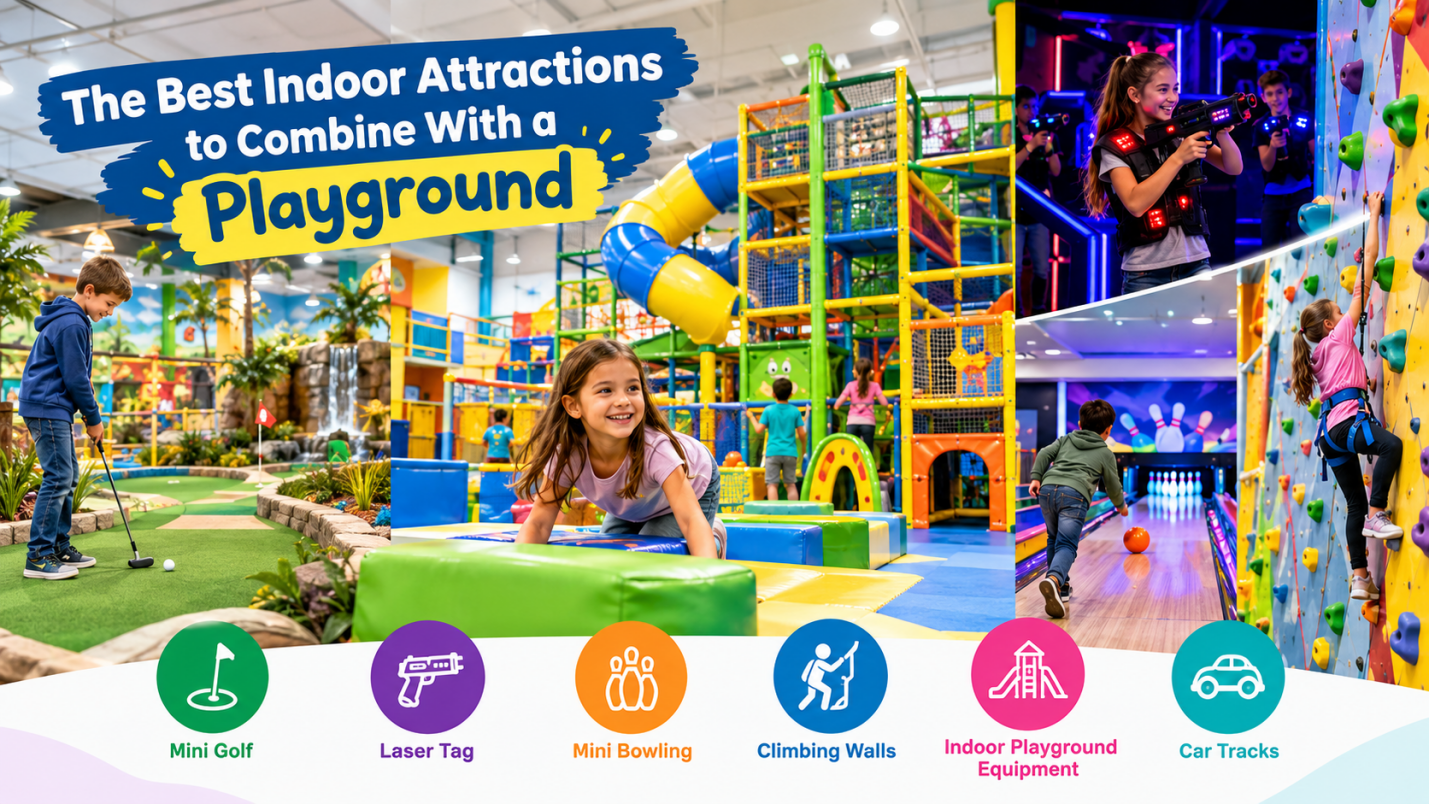
A standalone playground can pull in a solid crowd of families with young kids, but it has a ceiling. Once your customer base ages past ten or eleven, a play structure alone stops being the draw. The venues that consistently see repeat visits, longer stays, and bigger group bookings are the ones that pair their playground with additional indoor entertainment attractions, turning a single-purpose stop into a genuine family entertainment center. The right combination depends on your space and budget, but a handful of attractions consistently pay for themselves when added alongside a playground.
Mini Golf: Low Footprint, Broad Appeal
A mini golf attraction is one of the easiest additions to justify, both financially and logistically. It doesn’t require the ceiling height a playground does, it appeals to a much wider age range — parents and grandparents will happily play a round while younger kids are on the structure — and a well-themed course adds strong visual appeal to your venue’s marketing. Indoor mini golf also tends to have a fast learning curve for staff, low ongoing maintenance beyond basic upkeep, and flexible sizing, so even a modest 9-hole course tucked into an oddly shaped section of your building can generate meaningful revenue. Pairing mini golf with a playground effectively doubles your household appeal without doubling your footprint.
Laser Tag for the Older Crowd
This is where a lot of venues solve the “my kids have outgrown the playground” problem. A laser tag arena captures the eight-to-fourteen age range that a soft play structure or even a full climbing tower can’t hold onto for long. It also tends to be a strong birthday party draw, since group bookings for laser tag typically run longer and spend more per head than open play alone. The space requirement is real — laser tag needs a dedicated dark room with enough square footage for meaningful gameplay — but for venues with the room to spare, it’s one of the most reliable revenue generators among indoor entertainment attractions, particularly on weekend afternoons when party bookings cluster.
Mini Bowling as a Space-Efficient Add-On
Full-size bowling lanes are rarely practical inside a family entertainment center, but mini bowling has become a popular workaround. Shortened lanes with lighter pins and smaller footprints let venues offer a genuine bowling experience in a fraction of the space a traditional alley would need. It appeals across age groups, works well for both walk-in play and party packages, and its relatively quiet, low-impact nature makes it a good neighbor for a playground area rather than a source of noise conflict. For venues without the ceiling height or floor space for laser tag, mini bowling is often the next best option for extending appeal to older kids and adults.
Indoor Climbing Walls
An indoor climbing wall complements a soft play structure or playground unusually well because it scales with skill level rather than age alone — a wall with multiple routes at different difficulty levels keeps a five-year-old and a twelve-year-old both engaged, just on different sections of the same feature. Climbing walls also read as a premium attraction in a way that boosts perceived venue value, which supports higher admission pricing or membership tiers. The tradeoff is supervision: climbing requires more dedicated staff attention and safety equipment (harnesses, auto-belay systems, and mats) than most other additions on this list, so factor that into your staffing model before committing.
Car Track Attractions for a Different Kind of Movement
A car track attraction — whether pedal-powered, battery-powered, or slot-car based — gives younger kids a different kind of physical engagement than climbing or crawling, and it tends to be a strong differentiator since fewer venues offer it compared to the more common laser tag or mini golf combo. It works particularly well alongside a playground because it draws a similar age range without directly competing for the same physical space or supervision style. Smaller ride-on car tracks can fit into surprisingly modest footprints, making this a good option for venues that don’t have room for laser tag or mini golf but still want a second attraction beyond the playground itself.
Choosing the Right Combination for Your Space
Not every venue needs all five of these. The right combination depends on three things: your available square footage, your target age range, and your party and group booking strategy. A venue built around toddlers and preschoolers will get more value from mini golf and a car track than from laser tag, which needs an older crowd to make financial sense. A venue chasing birthday parties for elementary and middle-school-age kids should prioritize laser tag or a climbing wall, since those attractions drive the longer, higher-spend bookings that make party revenue a meaningful part of the business. Whatever combination you choose, the goal is the same: give every member of the family, from toddler to grandparent, a reason to stay longer and come back sooner.
A playground on its own is a good start, but it’s rarely the whole business. Pairing it with the right mix of indoor entertainment attractions extends your appeal across age groups, strengthens your party and group booking revenue, and gives families more reasons to choose your venue over a competitor down the road. Start with one addition that fits your space and budget, see how it performs, and build out from there as demand and revenue support it.